

Blogger news

Saturday, November 26, 2011
Wednesday, November 9, 2011
Tuesday, November 8, 2011
Did you...?
Did you try to write your mistakes...?
.
.
.
.
Try and if it works with you please write to me...!
Sunday, November 6, 2011




The Meaning of Hajj
The Meaning of Hajj

1. The Hajj is an inward journey to the Ka'bah of the heart and soul.
2. The Hajj consists of the Hajj of the Body (walking, standing, collecting and throwing), the Hajj of the Mind (performing the rites with understanding) and the Hajj of the Heart (performed in total submission to The Almighty).
3. The Ka'bah is not the destination; it is the starting point of one's commitment to cast away one's bad ways and to begin afresh a new Allah-centred life.
4. In tawaf, the pilgrim is like a drop of water that has become part of the river that is flowing to its origin, the ocean of Eternity. This life is a journey of return to The Merciful.
5. Sa'ee makes one aware that the Allah-centred life must be filled with "effort" (meaning of sa'ee). It is effort anchored in complete submission to Allah The Merciful that will bring the right results, just as it did for a mother who ran several times from one end of the valley to another in search of water in the harsh desert environment.
6. When the pilgrim leaves the Ka'bah in the direction of Arafah to begin his Hajj, he is moving away from The House to meet The Lord of The House. Arafat is outside the boundary of The Holy Land (Haram), signifying that The Lord of The House is everywhere, and is closer to man than he is to his own jugular vein. [The Holy Qur'an, 50:16]
[Excerpts from Hajj of the Heart by Dr Y Mansoor Marican, Ph. D.]
3. The Ka'bah is not the destination; it is the starting point of one's commitment to cast away one's bad ways and to begin afresh a new Allah-centred life.
4. In tawaf, the pilgrim is like a drop of water that has become part of the river that is flowing to its origin, the ocean of Eternity. This life is a journey of return to The Merciful.
5. Sa'ee makes one aware that the Allah-centred life must be filled with "effort" (meaning of sa'ee). It is effort anchored in complete submission to Allah The Merciful that will bring the right results, just as it did for a mother who ran several times from one end of the valley to another in search of water in the harsh desert environment.
6. When the pilgrim leaves the Ka'bah in the direction of Arafah to begin his Hajj, he is moving away from The House to meet The Lord of The House. Arafat is outside the boundary of The Holy Land (Haram), signifying that The Lord of The House is everywhere, and is closer to man than he is to his own jugular vein. [The Holy Qur'an, 50:16]
[Excerpts from Hajj of the Heart by Dr Y Mansoor Marican, Ph. D.]
Friday, November 4, 2011
Old Karachi...!
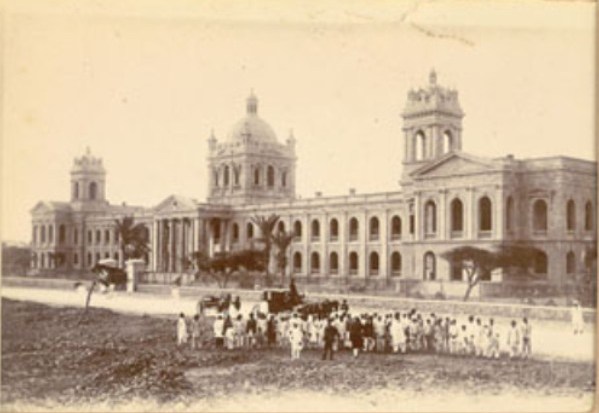
DJ Sindh Arts College
Photograph of the D.J. Sindh Arts College (now known as the D. J. Government Science College) of Karachi, taken by an unknown photographer, c.1900, Designed by James Strachan and considered this architect’s greatest achievement, the college was built between 1887 and 1893. Named after the Sindhi philanthropist Dayaram Jethmal, whose two family members contributed towards its cost, the building was constructed in the neoclassical, or ˜Italian architectural style". A considerable amount of money was spent on the interior of the college; the floors comprised mosaic tiles imported from Belgium and the eight-foot wide main staircase was fitted with ornamental cast-iron work from McFarlane & Company of Glasgow. Karachi, once the capital of Pakistan, is now the capital of Sindh province and the major port and main commercial center of the country. It was a strategically located small port at a protected natural harbor on the Arabian Sea north-west of the mouth of the Indus, and was developed and expanded by the British when they took over Sindh in the mid-19th century to serve the booming trade from the Punjab and the wheat and cotton regions of the sub-continent.

DJ Science Collge
Photograph taken in 1930

Independence Day Celebrations in Karachi in 1947

Clifton, Karachi in 1930

West Wharf, Karachi in 1930

Elphinstone Street, Karachi in 1930
The link below is a video tour of Karachi from about 70 years ago

DJ Science Collge
Photograph taken in 1930

Independence Day Celebrations in Karachi in 1947

Clifton, Karachi in 1930

West Wharf, Karachi in 1930

Elphinstone Street, Karachi in 1930
The link below is a video tour of Karachi from about 70 years ago
Subscribe to:
Posts (Atom)